AI INCIDENT REPORT
The Citation
That Didn't Exist.
A case study examining how unchecked AI-generated information entered a professional legal filing.
AI INCIDENT REPORT
A case study examining how unchecked AI-generated information entered a professional legal filing.
CASE FILE / 1728
Select a document to examine the case.
01 / INCIDENT
A court filing prepared with assistance from generative AI contained citation and quotation errors that were not adequately verified before the filing was submitted.
The incident arose in Hill v. Foundation Media LLC, a copyright case in federal court in New York. Attorneys representing Foundation Media submitted a filing that contained problems with legal citations and quotations. The court questioned whether unchecked use of artificial intelligence had contributed to those errors (Scarcella, 2026).
Cynthia Arato, an attorney representing Foundation Media, later told the court that another lawyer at Shapiro Arato Bach had prepared the initial draft and finalized the filing. According to Arato, the lawyer failed to properly verify AI-generated material before submission. The firm subsequently disclosed that tools developed by Harvey had been used to assist in preparing the filing (Scarcella, 2026).
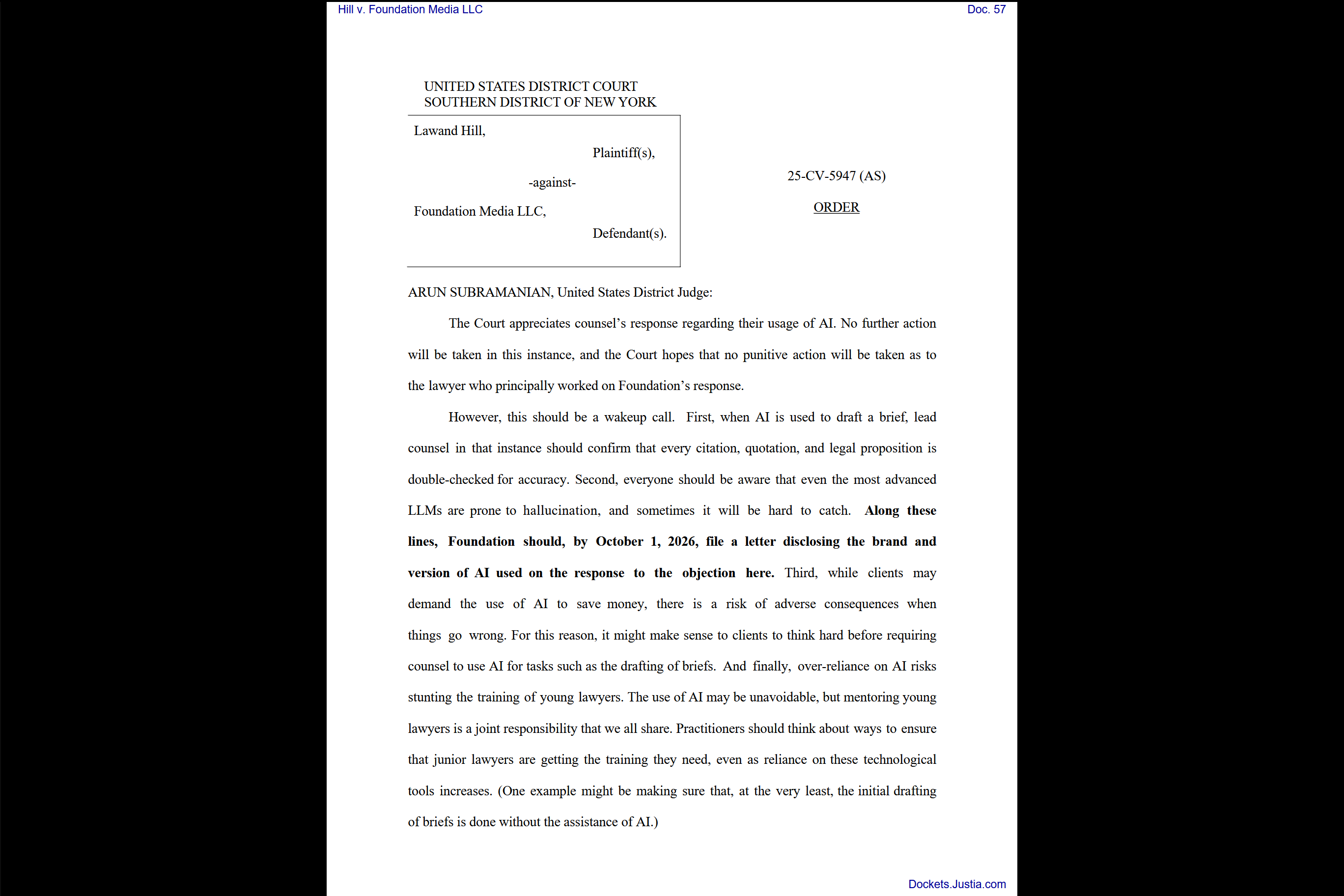
Judge Arun Subramanian ultimately declined to sanction the attorneys, but used the incident to warn about relying on AI-generated legal work without careful human review. His September 29, 2026 order emphasized that citations, quotations, and legal propositions produced with AI assistance must be checked for accuracy (Hill v. Foundation Media LLC, 2026).
02 / EVIDENCE
The incident can be reconstructed through independent reporting and court records. Together, these sources establish what was filed, how AI was used, how the attorneys explained the errors, and how the court responded (Scarcella, 2026; Hill v. Foundation Media LLC, 2026).
INDEPENDENT REPORTING
Reuters reported on Judge Arun Subramanian's response to the AI-related errors and documented the attorneys' explanation of how the filing had been prepared.
PRIMARY SOURCE
The declaration provides the firm's explanation of how the errors occurred and describes its response after the problem was identified.
Declaration of Cynthia S. Arato submitted in Hill v. Foundation Media LLC. Scroll inside the document to examine the complete filing.
VIEW FULL DOCUMENT ↗PRIMARY SOURCE
The court's order records its response to the incident and explains the broader concerns raised by AI-assisted legal work.
Filing 57, page 1. Judge Arun Subramanian's order addressing the use of AI in the Foundation Media filing.
Claims from individual participants are identified as their statements rather than treated as independent findings of fact.
03 / WHAT WENT WRONG
The incident was not the result of a single action. The available records show a sequence in which AI-assisted legal work moved through the drafting process without adequate verification before reaching the court (Scarcella, 2026).
CASE 1728 / FAILURE POINT
AI-assisted material passed through the professional workflow without being adequately checked before submission.
The available evidence points to a breakdown between AI-assisted drafting and final human review. The technology produced or assisted with material that required verification, but the professional workflow failed to catch the problems before submission (Scarcella, 2026).
04 / AFTERMATH
Once the citation and quotation problems were brought before the court, the incident shifted from a filing error into a broader examination of professional responsibility, AI safeguards, and the role of human review.
The court identified problems involving citations and quotations in Foundation Media's filing and questioned whether unchecked use of artificial intelligence had contributed to them (Scarcella, 2026).
Cynthia Arato apologized to the court and explained that another lawyer at Shapiro Arato Bach had worked on the initial draft and finalization of the filing. Her declaration stated that the AI-generated citations had not been properly verified (Scarcella, 2026).
Judge Arun Subramanian decided that no further action would be taken against the attorneys. However, he described the incident as a "wakeup call" and emphasized that AI-assisted legal work must still be carefully checked by lawyers (Hill v. Foundation Media LLC, 2026).
Arato stated that the conduct was contrary to the firm's existing policies and training and that additional safeguards would be implemented following the incident (Scarcella, 2026).
Judge Subramanian also raised a longer-term concern: increasing reliance on AI could interfere with the development of junior lawyers if they no longer gain experience researching, reasoning through, and drafting legal arguments themselves (Hill v. Foundation Media LLC, 2026).
05 / MY ASSESSMENT
The following section represents my personal assessment of the incident based on the evidence presented throughout this case file.
The failure was not using AI. The failure was trusting its output without verification.
In terms of the problem revolving around this case, it wasn't the use of AI but the misuse of it by taking it at it's word, even though the Harvey AI platform is designed specifically for use within the legal system it doesn't mean it's perfect and this isn't the only instance of this happening (RAGbase Legal Research Team, 2026). There are multiple examples like Mata v. Avianca, Inc where AI made up cases that were used to file legal motions (Goswami, 2023). and the only way to fix this is through the use of human verification. Verification is one of the core tenants of proper AI usage and it could've avoided many situations like these if someone took the time to verify the validity of the information provided by AI.
This incident directly connects to the verification principle in my AI Prompting Playbook. Regardless of how specialized or capable an AI system may be, its output still needs to be checked before it is relied upon.
VIEW PROMPTING PLAYBOOK ↗AI can assist the work. It cannot replace responsibility for the work.
06 / SOURCES
The following sources were used to document, verify, and analyze the events described in this incident report. Primary court records, independent reporting, industry analysis, and related incidents were used to examine the case from multiple perspectives.
AI INCIDENT DATABASE
Used to identify Incident 1728 and establish the AI incident record examined throughout this report.
AI Incident Database. (2026). Incident 1728: Law Firm Shapiro Arato Bach reportedly filed fictitious case citation and misattributed quotations using Harvey's legal AI platform in New York federal court.
REUTERS
Used for independent reporting on the incident, the attorneys' response, Harvey's involvement, the court's decision, and the broader concerns raised about the use of AI in legal work.
Scarcella, M. (2026, October 2). Judge warns AI could stunt lawyers' training and harm their clients. Reuters.
U.S. DISTRICT COURT
Used to document Judge Arun Subramanian's response to the incident, his decision to take no further action, his warning about verifying AI-assisted legal work, and his concerns about AI's effect on the training of junior lawyers.
Hill v. Foundation Media LLC , No. 25-CV-5947 (AS), Dkt. 57 (S.D.N.Y. Sept. 29, 2026).
COURT CAST
Used as additional reporting on the court's concerns about AI reliance, professional responsibility, and the effect AI could have on the development and training of younger attorneys.
Court Cast. (2026). AI may save law firms time, but judge warns it could cost young lawyers valuable training.
RAGBASE
Used to provide additional context on the limitations of specialized legal AI systems and the continuing importance of human verification when using AI-generated legal information.
RAGbase Legal Research Team. (2026, August 2). Harvey AI problems: What law firms are actually complaining about. RAGbase.
CNBC
Used to support the Mata v. Avianca example discussed in my personal assessment as another instance in which unverified AI-generated legal information entered a federal court filing.
Goswami, R. (2023, May 30). ChatGPT cited 'bogus' cases for a New York federal court filing. The attorneys involved may face sanctions. CNBC.
PRIMARY Original court records and official case documents.
SECONDARY Independent reporting and analysis used for context and corroboration.
RELATED Additional AI incident used to support the personal assessment.
Evidence reviewed. Sources documented. Analysis complete.